Table of Contents
Explore the historical, musical, and choreographic contrasts between Gujarat's two legendary folk art forms:
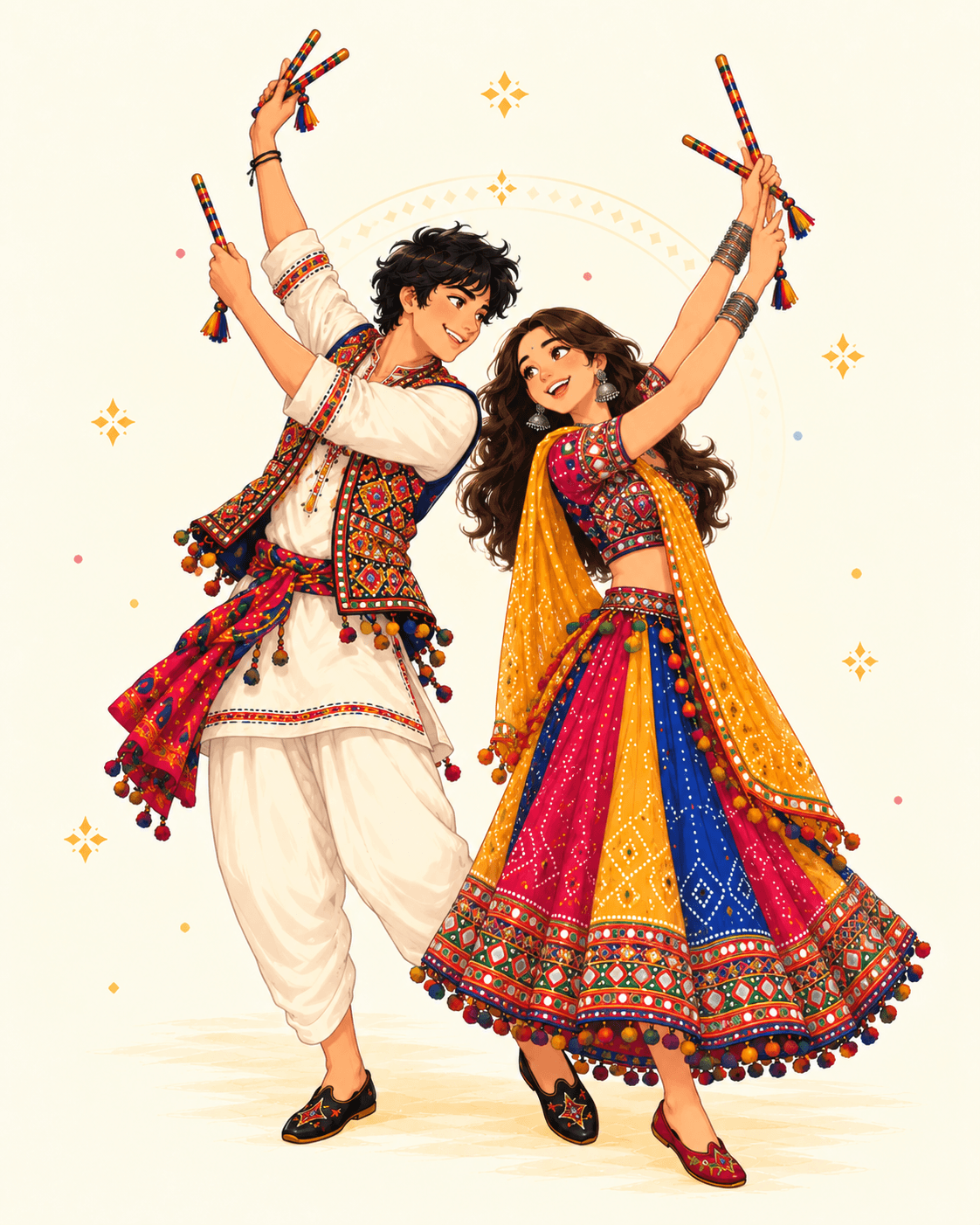
The Common Confusion During Navratri: Are Garba and Dandiya the Same?
Every autumn as Navratri approaches, posters across Delhi, Mumbai, Bengaluru, and Toronto announce grand "Dandiya-Garba Nights." For newcomers and even long-time festival attendees outside Gujarat, the two names blend into a single concept: dressing up in colorful traditional wear, gathering under festival lights, and moving to the thunderous beats of the dhol.
Yet step onto a traditional ground in Ahmedabad or Vadodara, and you will quickly realize that calling Garba "Dandiya"—or waving wooden sticks during a sacred Garba circle—is a major cultural faux pas. They are two distinct art forms born from completely different mythological roots, utilizing opposite props, and demanding different social structures.
The Golden Rule of Navratri:
All Garba is danced in a circle without sticks, using the palms of your hands. Dandiya Raas is danced in lines or pairs with wooden or metal sticks. If you are holding sticks, you are playing Dandiya Raas, not Garba.
What Is Garba? Spiritual Origin, Garbha Deep & Maa Amba Devotion
The word Garba originates from the Sanskrit word "Garbha", meaning "womb." Historically and spiritually, Garba is an act of deep reverence toward the divine feminine energy (Shakti), embodied in Goddess Amba (Durga).
At the physical and spiritual center of every authentic Garba arena stands the Garbha Deep—an earthen pot (often perforated with intricate holes) housing an ignited oil lamp (diya). This light symbolizes life inside the womb, reminding worshippers that divinity resides within every living being.
The Endless Circle of Life
Garba is danced in concentric circles rotating counter-clockwise around the central shrine. The circle has no beginning and no end, symbolizing the Hindu concept of Samsara: the cyclical nature of time, birth, life, death, and rebirth. As dancers move, the only stationary point in the entire universe is the divine light at the center.
Clapping as a Sacred Acoustic Offering
Garba utilizes no external props. Dancers use rhythmic hand claps—primarily 2-Taali (Be-Taali) and 3-Taali (Tran-Taali). The acoustic clash of thousands of palms clapping together creates a hypnotic, trance-inducing collective vibration designed to elevate consciousness and honor the Goddess.
What Is Dandiya Raas? Swords of Maa Durga, Mahishasura & Krishna Leela
While Garba is circular, devotional, and introspective, Dandiya Raas is theatrical, martial, and outwardly athletic. Its roots trace back to two distinct cultural streams: the martial reenactment of Goddess Durga's cosmic battle against the buffalo demon Mahishasura, and Lord Krishna's joyful Raas Leela with the Gopis in the groves of Vrindavan.
In the martial tradition, the polished wooden sticks (dandiyas) represent the celestial swords of the Goddess. When dancers strike each other's sticks with sharp, syncopated timing, the resounding clicks simulate the clash of swords in battle. The dance honors the victory of cosmic righteousness (Dharma) over dark forces.
⚔️ The Dynamics of Raas
Unlike Garba where dancers face inward toward a shrine, Dandiya Raas is organized into two facing lines or concentric rows of partners facing each other. Dancers strike their own sticks, strike their partner's sticks, pivot, and progress down the line to engage with the next opponent in continuous, rhythmic sparring.
7 Key Differences Between Garba and Dandiya Raas
To understand how these two dances diverge in practical execution, study this detailed comparison table covering everything from historical symbolism to partner rules and venue schedules:
| Comparison Dimension | Traditional Garba | Dandiya Raas |
|---|---|---|
| 1. Historical & Mythological Origin | Sanskrit Garbha (womb). Devotional worship of Goddess Amba and the cosmic circle of life around the Garbha Deep. | Martial reenactment of Goddess Durga's sword duel with Mahishasura, combined with Krishna's Vrindavan Raas Leela. |
| 2. Props & Equipment | No props. Bare hands only, clapping in sync (2-Taali, 3-Taali) and sweeping arm gestures. | Dandiya sticks. Pair of polished wooden, fiberglass, or metallic rods per dancer. |
| 3. Geometric Dance Formations | Massive concentric circles rotating counter-clockwise around the central deity or Murti. | Two parallel facing rows or paired concentric rings moving in opposite directions (clockwise vs counter). |
| 4. Tempo & Progression | Starts slow and meditative (Vilambit laya) and gradually accelerates into blistering Dodhiya spins (Drut laya). | Fast, steady, syncopated martial cadence from the very first beat; structured in 4-strike or 8-strike sequences. |
| 5. Footwork & Body Posture | Graceful sweeping bends, side-steps, torso sweeps, 360-degree spins, and undulating upper-body sway. | Linear forward-and-back steps, knee dips, jumping pivots, sharp wrist snaps, and defensive posture. |
| 6. Partner Requirements | Solo-friendly: You can step into any open circular ring alone and flow with the group. | Strictly Paired: Requires a partner facing you to strike sticks with. Without a partner, you cannot play. |
| 7. Typical Ground Timing | Early evening (approx 8:00 PM – 10:45 PM), beginning with holy hymns and building tempo. | Late night (approx 11:00 PM – 2:00 AM+), after the midnight Aarti and band intermission. |
Dance Formations: Concentric Circles vs. Parallel Facing Rows
The physical geometry of the dance floor changes dramatically when moving between Garba and Dandiya Raas. Understanding these spatial patterns prevents awkward collisions and helps you find your natural rhythm on crowded grounds.
Garba: The Concentric Mandalas
Garba is danced in expanding concentric circles around the central Garbha Deep or deity. Every circle moves synchronously counter-clockwise:
- Innermost Ring: Experienced dancers performing fast-cadence 16-step Dodhiya, intense knee-dips, and rapid 360-degree spins.
- Middle Rings: Steady intermediate dancers performing classic 3-Taali and 6-step Dodhiya.
- Outermost Rings: The most relaxed, beginner-friendly circles practicing basic 2-Taali with gentle, forgiving pacing.
Dandiya: The Carousel Lines
Dandiya Raas organizes dancers into two facing linear rows or dual-ring carousels:
- Linear Facing Rows: Line A faces Line B. You strike your own sticks, strike your partner's sticks, take a side-step to the right, and instantly face the next person in line.
- Dual Concentric Rings: The inner circle moves clockwise while the outer circle moves counter-clockwise. With every 4 or 8 beats, dancers strike their partner's sticks and rotate one position forward, meeting dozens of new partners each song.
- Group Stars & Crosses: Advanced Raas troupes form 4-person or 8-person crosses where sticks clash simultaneously in a central hub.
Use of Sticks vs Hand Clapping (2-Taali, 3-Taali & Props)
The acoustic heartbeat of Garba is biological: the human palm striking against palm. In Dandiya, the sound is percussive and mechanical: polished hardwood striking against hardwood. This creates totally different sensory atmospheres.
👏 The Claps of Garba: 2-Taali & 3-Taali
In Garba, the clapping pattern dictates your footwork:
2-Taali (Be-Taali)
A steady 4-count rhythm. Step right on count 1, clap on count 2, step left on count 3, clap on count 4. Ideal for beginners, relaxed pacing, and singing along with the choir.
3-Taali (Tran-Taali)
A 6-count or 8-count syncopated rhythm. Three distinct claps executed with dynamic torso bends, one clap high at chest level, one low near the knee, and a rising clap accompanied by a spin.
🥢 The Sticks of Dandiya: Materials & Strikes
Dandiya sticks come in multiple traditional and modern varieties:
Carved Teak / Rosewood
The traditional choice. Heavier weight gives clean, resonant acoustic cracks without splintering.
Fiberglass & Metal
Lightweight, virtually unbreakable, often adorned with bandhani fabric, mirrors, and tiny ghunghroo bells.
LED & Neon Sticks
Popular at modern indoor concerts in Mumbai and diaspora grounds, creating glowing light trails in dark arenas.
Rhythm and Movement Progression: Slow Devotion vs. Constant Strike
Another core distinction lies in how the music unfolds over time. A Garba set is an emotional journey that accelerates over 45 to 60 minutes, while Dandiya Raas is an intense rhythmic sprint from the opening beat.
The 3-Phase Garba Arc (From Prayer to Frenzy)
Phase 1: Vilambit Laya (Devotional Stuti)
Slow, meditative tempo (60–80 BPM). Songs dedicated to Maa Amba, Bahucharaji, and Kalika. Dancers move with dignified, graceful reverence, sinking into slow knee bends and deep claps.
Phase 2: Madhya Laya (Dodhiya Progression)
Moderate tempo (90–120 BPM). The dhol picks up speed, leading the ground into synchronized 4-step, 6-step, and 8-step Dodhiya sequences. Circles tighten and twirls become continuous.
Phase 3: Drut Laya & Sanedo (Peak Energy)
Blistering tempo (130–160+ BPM). The lead singer yells "Aieee halo!" or breaks into Sanedo. Dancers spin at maximum velocity until the orchestra hits the final climax drum roll.
In contrast, Dandiya Raas operates on a continuous, driving 4-count or 8-count syncopation. Because every movement involves clashing physical sticks with another human being, the tempo cannot fluctuate wildly without causing painful knuckle collisions. It maintains an energetic, dance-floor-ready groove throughout the set.
Partner Requirements: Why Garba Allows Solo Joining, Whereas Dandiya Strictly Needs a Partner
Perhaps the most significant practical difference for festival goers is the social requirement for each dance. Your strategy for Navratri depends entirely on which style you plan to dance:
Step In Anywhere, Anytime
Garba is a community circle. You do not need an assigned partner to participate. If you arrive alone, you can simply walk up to any circle matching your speed, match their footwork, and slip between two dancers. The circle expands naturally to welcome you.
Zero Solo Dancing Possible
In Dandiya, half of the dance involves clashing sticks against an opponent. If you do not have a partner facing you in the line, you have nothing to hit on counts 2, 4, 6, and 8. Arriving solo or in an odd-numbered friend group often results in standing awkwardly on the sidelines holding useless sticks.
Which One Beginners Will Encounter: The 11:00 PM Switch
If you are attending a commercial Navratri ground (such as in Mumbai, Surat, or Ahmedabad club grounds), the evening almost always follows a predictable two-part timetable. Knowing this timeline ensures you don't carry sticks onto the floor too early or leave before the best sets begin:
The Garba Circles
Sticks stay in bags or coat checks. Dancers form giant circles for slow stutis, 2-Taali, 3-Taali, and rapid Dodhiya. Beginners should use this time to find their rhythm in the relaxed outer circles.
Aarti & Intermission
The entire arena goes silent for the sacred Maha Aarti of Goddess Durga. Following prayers, the orchestra takes a short breather while dancers grab hydration and fetch their dandiya sticks.
Dandiya Raas Sets
The circular formations disperse into long parallel rows and carousel wheels. Sticks clash to fast-tempo Gujarati folk-pop and Bollywood fusion beats until curfew.
Regional Variations: Vadodara, Ahmedabad, Mumbai & Beyond
How Garba and Dandiya are celebrated depends heavily on which city you find yourself in:
👑 Vadodara (Baroda) · Pure Garba Without Sticks
Vadodara Partners →Vadodara is known as the Garba capital of the world. At iconic grounds like United Way of Baroda, Maa Shakti, and Faculty of Fine Arts, Dandiya sticks are rarely seen. Over 30,000 dancers sing live choral hymns in pure, hypnotic synchrony—dancing only with hands. Explore our dedicated Vadodara Garba partner guide to connect with local circles.
🏙️ Ahmedabad · Dodhiya Power & Midnight Raas
Ahmedabad Partners →In Ahmedabad (Karnavati Club, Rajpath Club, GMDC Ground, and SG Highway party plots), the evening is a dynamic hybrid. The first half features intense 12-step and 16-step Dodhiya spins, while the late hours transition into fashion-forward Dandiya raas competitions under laser lights. Find your companion on the Ahmedabad Garba network.
🌟 Mumbai · Celebrity Singers & High-Voltage Dandiya
Mumbai Partners →In Mumbai (from Falguni Pathak’s arena in Borivali to Korakendra and Dome SVP Stadium), Dandiya Raas takes center stage. The emphasis is on Bollywood-infused beats, fast stick clashes, and paired choreography. Having a coordinated partner with quick reflexes is essential for navigating Mumbai's energetic rows. Explore our Mumbai Dandiya & Garba hub to learn more.
Frequently Asked Questions About Garba vs. Dandiya
Got more questions about stick etiquette, rhythm styles, or finding partners? Here are answers to the most common queries:
Explore More Navratri 2026 Guides & Resources
Continue your preparation for the world's longest dance festival with our dedicated guides:
Garba Partner Portal
Find circular Garba partners for 2-Taali, 3-Taali, and Dodhiya spins.
Dandiya Partner Finder
Match with paired stick raas dancers for synced rows and coordinated clash timing.
Partner Matching Guide
Comprehensive tips on coordinating festival nights, dance skill levels, and festive vibes.